You are browsing the archive for Steve Bright.

After Gin Lane: Giving it all away

September 6, 2012 in Comment, General

Following From Gin Lane to the Information Superhighway we see that there are cartoonists who are positively embracing this new era of social media and sharing.

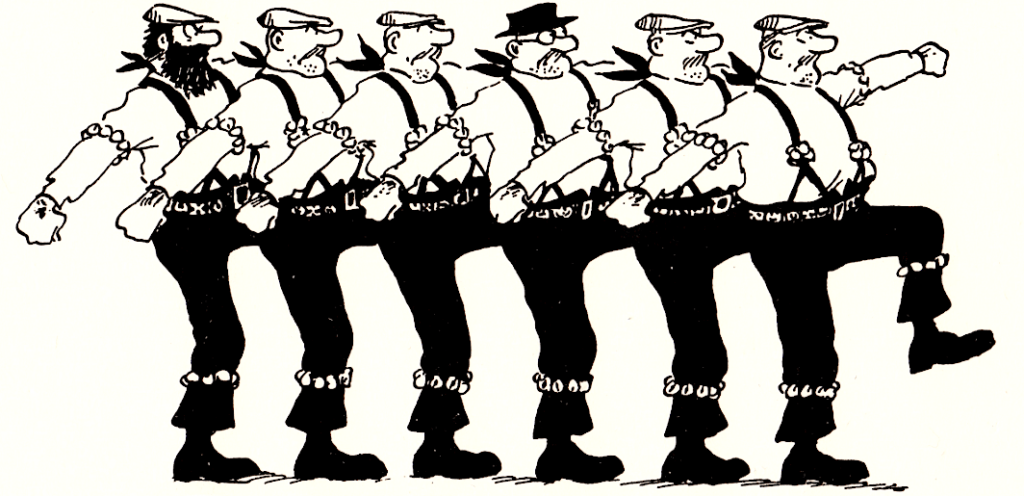
Hairy Steve © Steve Bright @ Procartoonists.org

Webcomics and viral cartoons are a couple of the ways that you can effectively give your work away to the web but get paid back by other means. Successful webcomics work on a business model based on the idea that you give away a regularly updated cartoon on your website and build a following of readers who come back day after day. British examples include John Allison‘s Bad Machinery or Jamie Smart‘s Corporate Skull.

© Peter Steiner @ Procartoonists.org

The profit comes from selling merchandise to the more loyal fans – bound compilations, prints, sketches, T-shirts, toys and so forth. Similarly, viral cartoons can drive lots of new readers to your website. How much money can be directly attributed to virals is arguable, although, for example, the well-known New Yorker cartoon “On the Internet, nobody knows you’re a dog” is said to have earned its creator, Peter Steiner, more than $50,000.

The website Kickstarter has recently become one of the biggest publishers of comic books in the USA, from independent cartoonists using the crowd-funding model to raise money directly from their fan-base. Here in the UK, Procartoonists.org‘s very own Adrian Teal (The Gin Lane Gazette) and Steve Bright (Hairy Steve – in collaboration with Jamie Smart) have developed their own crowd-funded projects.

We’ll be considering another aspect of the communication change – After Gin Laneand what it means for cartoonists next week

The Sun shines on cartoonists

August 8, 2012 in General, News

Tim Harries strip cartoon

© Tim Harries for The Sun @ Procartoonists.org

Tim Harries has started drawing a new strip for children in The Sun, one of many Procartoonists.org members providing cartoons for the UK’s best-selling paper. Tim told the blog:

“I got a call asking for a strip to run in a kids’ pull-out section of their TV guide during the school holidays. The deadline was tight but I had a family strip in development that I thought was suitable, they liked it and went with it, asking me to make the teenage son the main character. They came up with the title “Adam’s Adventures” – seems as good a title as any! The initial plan was to run for four weeks, but that’s been extended.”

Clive Goddard's Sunday Smile

© Clive Goddard for The Sun @ Procartoonists.org

Procartoonists.org member Clive Goddard has been drawing ”Sunday Smile”, a cartoon panel with a historical theme, above, for the Sun on Sunday since it launched earlier this year, above.

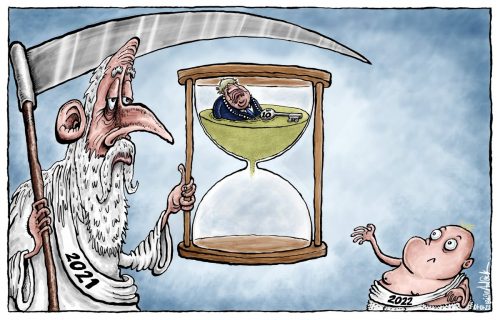
Editorial cartoons in the paper are regularly provided by Steve Bright, Andy Davey and Gary Barker. Click here for an archive of their cartoons. So if you see a cartoon in The Sun, the chances are it was the Procartoonists wot done it.

Avatar of Royston

by Royston

Shrewsbury Cartoon Festival 2011

April 12, 2011 in Events

Here is another selection of cartoon previews from the Personal Bests exhibition, one of the headline events at this year’s Shrewsbury Cartoon Festival which starts on Thursday (April 14).

Personal Bests exhibition cartoon at Bloghorn © Steve Bright

Personal Bests exhibition cartoon at Bloghorn © Steve Bright


Personal Bests exhibition cartoon at Bloghorn © Gerard Whyman

Personal Bests exhibition cartoon at Bloghorn © Gerard Whyman


Personal Bests exhibition cartoon at Bloghorn © Cathy Simpson

Personal Bests exhibition cartoon at Bloghorn © Cathy Simpson


Come back to Bloghorn for coverage of the festival as it happens, or follow the hashtag #shrews11 on Twitter.

From Herriman to Holte: Another ten great cartoonists

January 19, 2011 in Comment

The cartoonist Gerald Scarfe has made a list of his ten favourite cartoonists, for the Daily Mail website. It includes some inarguable choices as well as some surprising ones.

Ronald Searle, widely regarded as Britain’s best living cartoonist, is on there. There are also choices from the worlds of fine art, such as Picasso, and film-making, which is represented by Walt Disney, more for his skill at getting great work from others than his own drawing talents.

We asked members of the Professional Cartoonists’ Organisation, which runs the Bloghorn, to name their favourite cartoonists not on the Scarfe list. It’s not a poll, or a “top ten”, just an informal list of another ten great artists, and it shows the wealth of variety and creativity to be found in the world of cartooning.

Hector Breeze cartoon

1. Hector Breeze (Born 1928). Picked by Pete Dredge: “A master of the pocket cartoon. Out of the mouths of his mundane, benign, chunkily drawn characters comes the sharpest of captions.”

Robert Crumb cartoon

2. Robert Crumb (Born 1943). Picked by Royston Robertson: “He has been satirising the way we live since the 1960s with his dense, inky, cross-hatched drawings, displaying human folly in all its gory glory. Not for nothing was he described by the art critics Robert Hughes as ‘the Bruegel of the last half of the 20th century’.”

George Grosz painting

3. George Grosz (1893-1959). Picked by Matt Buck and Andrew Birch (both blatantly ignoring the brief of people not on Scarfe’s list, Bloghorn notes!) Matt says: “Grosz drew with an unsparing eye and produced powerful reflections of what people do rather than what they say they do.” Andrew adds: “For me German Expressionism was one of the most important art movements of the 20th century, whose brutal and honest line laid the foundation for many later cartoonists like Steadman.”

Heath Robinson cartoon

4. William Heath Robinson (1872-1944). Picked by Rupert Besley: “He was an original, creating a wonderful, instantly recognisable world of his own. He satirised the growth of mechanisation, but did so in a gloriously enjoyable way that always kept the human at the centre of it all. Which other cartoonist has added his name to the language and booked his place in every dictionary?”

George Herriman cartoon

5. George Herriman (1880-1944). Picked by Wilbur Dawbarn: “From the gorgeously scratchy line work and absolute poetry of the writing in the early years, to the sheer majesty of composition in the latter years, Herriman’s Sunday Krazy Kat pages are, to my mind, some of the finest examples of comic art ever penned.”

Holte cartoon

6. Trevor Holder, aka “Holte” (Born 1941). Picked by Roger Penwill: “Glorious technique, a master of expressive line and a very funny, wicked sense of humour. Some of his cartoons are timeless classics.”

Kliban cartoon

7. Bernard Kliban (1935-1990). Picked by Chris Madden: “I came across a book by B. Kliban: Cat Dreams. I’m not sure what they’re about. I’m not even sure if they’re funny (do cartoons actually have to be funny?) But they’re brilliant. Apparently he grew to detest drawing cats in the end, but they were what everybody wanted. Beware success.”

David Law cartoon

8. David Law (1908-1971). Picked by Steve Bright: “Beautifully fluid and loose line, amazing perspectives and angles, and the master of life and motion in all that he drew. Law inspired millions of kids to pick up a pencil through his marvellous work in the Beano, Dandy and Topper.”

Phil May cartoon

9. Phil May (1864-1903). Picked by Mike Turner: “A breakthrough in culling captions down to a minimum. Great art, brilliant caricatures, sheer good humour relating to ‘the man in the street’ or the ‘man on the horse-drawn omnibus’

Bill Tidy cartoon

10. Bill Tidy (Born 1933). Picked by Bill Stott: “For his excellent gags and consummate drawing, especially in his history-based stuff.”

What do you think of the list? Got a favourite cartoonist you’d like to add to it? Let us know in the comments below.

Artist of the Month – Steve Bright

August 28, 2009 in Events

Bloghorn_Bright_cartoon

In our last question for August, Bloghorn asked our Artist of the month, Steve Bright, what is the future of cartooning in the digital age?

I think (with some sadness) that the future of cartooning IS the digital age. Not only do I supply almost all of my artwork in digital format these days (and other than my caricature gig work, it’s 100%),
but almost every client I’ve worked for in recent times has wanted it that way.

Perhaps that’s not entirely surprising, since in most cases they find me via computer technology, and my website in particular. But none the less, even the older traditional markets such as the Beano and Dandy now receive their artwork digitally as the norm, and put up with physical pieces of artwork cluttering their desks only because some of the artists they still favour (I’m no longer one of them), who are not computer savvy, are worth the inconvenience.

From a nostalgic viewpoint, I much prefer the vision of the office in the “olden days”, with artwork adorning every desktop, and the smell of Cow Gum fighting with cigarette and pipe smoke for dominance. But in the later years, when all they wanted from me was a high resolution jpeg, I got to keep all my original artwork. Before that became the norm, I, along with every other freelancer, was sending them page upon page of original art every week, never to be returned to any of us. That alone has made me more grateful for the technological advancements than I can put into words, but there’s more – much more!

Anyone in our business who doesn’t at least try to embrace as much of it as possible is not going to last much longer in the game. I don’t say that with any sense of complacency, but as a fact that faces us all. The key is not to think you need to know it all in order to use the technology. You pick up a phenomenal amount as you go along, and it’s a constant learning curve for even the most advanced of users, but always at your own pace.

It can also be fun – which is our business after all.

Our thanks to Steve for his answers which you can find along with those from many other professional cartoonists in our Artist of the Month archive.

Artist of the Month – Steve Bright

August 21, 2009 in Events

The PCO Artist of the month for August is Steve Bright and Bloghorn asked him which other cartoonists’ work he admired.

There are far too many names to list here, and yet I’m neither a follower nor expert in any other cartoonist’s work. I have a few books by other cartoonists I enjoy, but no definitive collection.

There are also many little known names whose work almost certainly influenced a large percentage to pick up a pencil and begin drawing cartoons. They seldom get a mention beyond the forums populated by UK comics geeks, so I’ll mention a few here.

Cartoon greats such as David Sutherland, Robert Nixon, Ron Spencer, Bob McGrath, Ken Harrison, John K. Geering, Jim Petrie, Reg Parlett and Tom Paterson may reside deeper in the shadows than the more famous comic greats such as Ken Reid, Leo Baxendale and Dudley Watkins, but they have had every bit as profound an influence on me as any other cartoonist.

Many cartoonists cut their cartoon teeth (like me) on the likes of the Beano, Dandy and Whizzer & Chips. They may not know the names, but they certainly were influenced by them.

Bloghorn_Steve_Bright_No2
Did Steve have any tips for wannabe cartoonists?

These days, I would not advise anyone to take up drawing cartoons as a full-time career, no matter how talented they were. I actually feel it would be irresponsible and my conscience won’t allow me to do it. Very different to how I viewed it less than 20 years ago.

However, assuming we’re talking about wannabes who are already beyond the Dissuasion Stage, and are focussed, determined and single-bloody-minded enough to have a go regardless, the only really sound advice I think I could give them would be … to copy!

Studying other cartoonists is important, but only by copying (or even tracing) their work will you begin to appreciate the nuances of how they draw, and it will teach you more than any verbal advice can ever come close to. Naturally, I’m not suggesting that anything you copy can be claimed (or sold) as your own, but as a learning device, there is no better in my opinion.

Much of the early part of my career was built on an ability to “ghost” the work of other artists, and that skill was developed by copying the characters as closely as I could, even (and especially) down to the thickness of line they used, and emulating those characteristics as a style, and not just as the odd figure or two.

My own style is a hybrid of many others, and I can vary it significantly from project to project. Certainly, there are many cartoonists who have managed to earn a good living with one particular style throughout their career, but I do think they are the exception.

Being adaptable opens many more doors, some more inspiring than others, but when there are bills to be paid, there’s little room for tying your integrity to one style of drawing. Sometimes a writing ability can be a real asset too.

Artist of the Month – Steve Bright

August 14, 2009 in Events

Bloghorn_Steve_Bright_No3

Bloghorn asked PCO Artist of the Month, Steve Bright, how he makes his cartoons.

I have only just become fully digital, and now require an alternative power source to coffee and Chocolate Hobnobs to produce cartoons. It’s been a gradual process however.

The majority of my career has been carved out using automatic pencils, no-buff erasers, Gillott’s 303 nibs dipped in Rotring black drawing ink, sable brushes dipped in Winsor & Newton coloured inks, all employed upon A2 sheets of bleed proof marker pad paper or Bristol Board.

In the past ten years or so, computer technology has replaced or diminished the role of all of those elements. The recent arrival of my Wacom Cintiq has banished them from my drawing board completely. I now do everything using the Cintiq linked to my laptop, and my biggest fear is no longer a missed deadline, but a prolonged power cut.

Oddly, most of the tools I’d used in the early years was pretty much the same as that used by cartoonists for the previous hundred years. But such is the pace of the technology now, I’ve outgrown a scanner and several drawing tablets in a just few years. It’s a little bit scary for someone who swore he’d never change his drawing ways when others were dipping their toes in the cyber waters.

I’ve taken much longer than some to become a convert. But I have no regrets, and I wouldn’t hesitate to recommend others to do it when the time is right for them. I know I shall revisit the old methods again eventually, but for fun rather than commerce. There is no turning back now.

Artist of the Month – Steve Bright

August 7, 2009 in Events

Bloghorn_Steve_Bright_No1

The Bloghorn Artist of the month for August is Steve Bright. We asked him how he became a cartoonist.

If there is a conventional route to becoming a cartoonist, it certainly wasn’t mine. From the age of seven I have drawn cartoon pictures which impressed my family and made my friends laugh. I concentrated on my strengths and my ability has grown with me.

At school, having established that I could draw quite well in the early years, my themes later revolved around the typical teenage angst subjects like euthanasia, crucifixion and war. Even if no-one else was laughing at my art back then, I privately derived great mirth from the reactions it invoked. This act of self-pleasure eventually evolved, as I gradually realised that the power to make others laugh at my artwork was a great stimulant, and was in itself highly addictive.

Perhaps it was that inability to take myself or my art seriously which led to my application rejection by Edinburgh Art College (or maybe it was my portfolio of death and debauchery), but that and my arrogance at the time were the two single most important factors that led to my subsequent career as a cartoonist. Rather than head to Dundee to attend my second choice art college, I went there to take up my first full-time job as a journalist, for an advertised career in one of the local papers. If I couldn’t be a successful artist, I was going to be a successful writer, after serving my apprenticeship on the Dundee Courier or Sunday Post.

It wasn’t until the day I started at the Dundee HQ of D.C. Thomson & Co. Ltd. that I found out I was to be the office junior on ‘The Beano‘. Within a fortnight I had captured the regular weekly script-writing chores for Billy Whizz, Biffo the Bear, The Nibblers and Pup Parade, all to myself. Six years later, and with a wealth of experience picked up by handling artwork drawn by many of the greats of the British comic industry, I quit, and jumped the fence to become a freelance cartoonist. The rest, as they say, has been lunacy…

There will be more from our interview with Steve at Bloghorn next Friday.

Avatar of Royston

by Royston

Shrewsbury 2009 #5

April 21, 2009 in General

shrewsbury5_bright

Cartoon Exhibition: The Beano in Dundee

August 4, 2008 in General


Amid the coverage of the London launch of the Beano and Dandy Birthday Bash last week at the Cartoon Museum, we should mention that there’s a parallel exhibition in the Beano and Dandy’s home town of Dundee. The exhibition is being held at the Lamb Gallery at the University of Dundee until the 20th September, Monday to Friday 9.30-20.30, Sat 9.30-12.00, and best of all, it’s free to enter!

More details at the University of Dundee’s website. Not being able to attend ourselves, Bloghorn would be keen to hear any reports from the exhibition.

Getting back to the London event, ITN sent a reporter along to cover the event last week, and here’s their report.

Thanks to Lew Stringer for his Blimey! It’s another blog about comics for the above links.

UPDATED:
PCO member Steve Bright, who worked for the comics for more than twenty years, asks us to point out that ITN have made a clanger in their copy. The current editor of The Beano is Alan Digby, not Rigby. Independent Television News, what can you say … thanks for pointing that out Steve.

It’s British cartoon talent